
The Town of Guilford, CT has used a multi-year collaborative and multi-pronged approach to simultaneously address four invasive aquatic plant species found in Lake Quonnipaug: curly-leaf pondweed, fanwort, Eurasian watermilfoil, and variable-leaf watermilfoil. These species have been present in the lake since monitoring began in 2004. Previous treatments in 2016-2020 brought the milfoil species under control, but there was no impact on fanwort or curly-leaf pondweed. In 2022, invasive species still occupied 27% of the littoral zone, prompting a new approach. The long-term actions undertaken by the Town starting in 2023 have resulted in the reduction in coverage and density of all invasive species while maintaining native species diversity and plant coverage within the system. The management plan has relied on extensive mapping of plant beds and initial herbicide applications of fluridone (tradename Sonar) and diquat to gain control of the invasives in the lake while longer term actions going forward will transition toward control using non-herbicide techniques such as volunteer hand harvesting or diver harvesting. A detailed analysis of the results of the control program will be presented that documents control of invasive species with minimal impact to native plant species.
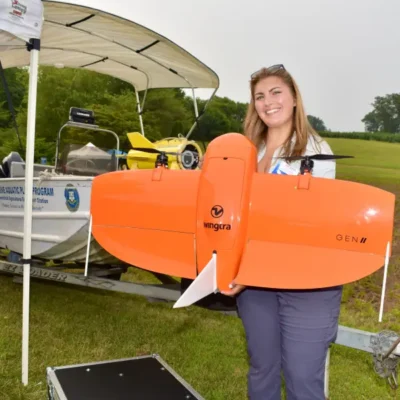
Summer Weidman is a Research Technician II and Lake Manager Associate at the Connecticut Agricultural Experiment Station in the Office of Aquatic Invasive Species. She has nearly a decade of experience leading statewide surveys to monitor invasive aquatic plants, specializing in field identification, distribution mapping, and geospatial analysis. Her work supports the development of effective management strategies for hydrilla and other invasive species by combining rigorous field data collection with advanced mapping tools. In addition to her applied research role, Summer is pursuing a Ph.D. in Natural Resources at the University of Connecticut, where her research focuses on applying remote sensing technologies to improve detection and monitoring of invasive species, specifically hydrilla.
This program is co-sponsored with the Guilford Conservation Commission and is free and open to all.
Please register.